A History of Titanium in Watches
Last updated
Titanium is now everywhere in watchmaking, from thousand-dollar microbrand divers to seven-figure tourbillons. It was not always so. This is the story of how a stubborn aerospace metal went from a 1970 curiosity to the default choice for a modern tool watch, and the makers who pushed it there.
The metal before the watch
Titanium was identified in 1791 by the Cornish clergyman and amateur geologist William Gregor, and named a few years later by the German chemist Martin Heinrich Klaproth after the Titans of Greek myth. For more than a century it stayed a laboratory curiosity, because separating pure titanium from its ore is genuinely difficult. That changed in 1940, when William Kroll developed the process still named after him that made industrial-scale titanium possible.
The metal found its first real home in the Cold War aerospace industry. It is strong, far lighter than steel, and holds its properties at high temperature, which made it ideal for jet engines and airframes; the SR-71 Blackbird was famously built largely of titanium. In 1954 American metallurgists formalized the alloy that watchmaking would later lean on most, Ti-6Al-4V, titanium with roughly six percent aluminium and four percent vanadium. The watch world knows it as Grade 5.
1970: the first titanium watch
The first titanium wristwatch came from Japan. In 1970 Citizen released the X-8 Chronometer, a slim dress watch in a commercially pure titanium case. It was as much a manufacturing statement as a product: titanium is hard to machine and harder still to finish cleanly, and pulling it off in 1970 announced Citizen as a materials pioneer. The company never really stopped, and decades of titanium research led to its surface-hardened Super Titanium, still one of the most important names in the field.
Titanium galls and work-hardens when machined, blunts cutting tools quickly, and is reactive enough that finishing it to a clean polish is an art in itself. Every early titanium watch was a small engineering victory, which is why the metal stayed rare for years after Citizen proved it could be done.
Into the sea: the first titanium divers
Diving exposes exactly the weakness that titanium answers, saltwater corrosion, so it is no surprise the metal went underwater early. In 1975 Seiko released its 600 m Professional, the original "Tuna," whose shrouded case used titanium and is widely credited as the first titanium dive watch. The logic was simple: a watch that resists the sea and stays light on a big case is a better tool, and titanium delivered both.
1980: Porsche Design and IWC make it luxury
If Citizen and Seiko proved titanium worked, Porsche Design and IWC made it desirable. The 1980 IWC Porsche Design Titan Chronograph (reference 3700) is widely regarded as the first titanium-cased chronograph, and it brought the metal, and its muted, all-business grey, to a European luxury maker. Two years later the same partnership produced the Ocean 2000, a 2000 m titanium diver developed with military combat divers in mind. With those watches the metal picked up something it had not carried before, a sense of desirability sitting on top of the engineering.
The 1980s materials race
Through the 1980s the big makers experimented. Omega built the Seamaster in titanium and explored exotic blends, including titanium paired with tantalum. Citizen pressed on with the problem every titanium owner notices, that bare titanium scratches, and answered it with surface hardening: its Duratect family of treatments diffuses a hard skin into the metal so the case resists everyday marks far better than untreated titanium. That work is what turned ordinary titanium into the branded Super Titanium that Citizen still sells today.
The 1990s: a tool-watch standard
By the 1990s titanium had stopped being a novelty and become a category. The German maker Sinn hardened titanium with its Tegiment process for instrument watches; Breitling, Omega and others offered titanium across their sports lines; and Seiko and Grand Seiko refined their own High-Intensity Titanium. The pitch had crystallized into the one buyers still hear: lighter, kinder to the skin, and immune to rust, with surface hardening to manage the scratch trade-off.
Haute horlogerie and the composite era
The 2000s pulled titanium upmarket. Richard Mille built a brand on Grade 5 titanium baseplates and bridges, treating the aerospace alloy as a structural material rather than just a case. Audemars Piguet, Panerai, Hublot and others made titanium a regular option at the top of the market. Then makers began ceramizing it: IWC introduced Ceratanium in 2017, a titanium alloy whose surface is converted to a hard, scratch-resistant ceramic, and Panerai followed with its own Ti-Ceramitech. These titanium composites keep the lightness of the base metal while answering the scratch problem at the surface.
Rolex finally commits
One conspicuous holdout was Rolex, which leaned on steel and gold long after rivals embraced titanium. That changed in the 2020s: the experimental Deepsea Challenge of 2022 was built entirely in Rolex's own RLX titanium, a Grade 5 alloy, and in 2023 the Yacht-Master 42 RLX Titanium made it a catalog model. For the most conservative name in the industry to build a production titanium sports watch tells you how completely the material had won the argument.
The democratization
The most recent chapter belongs to the microbrands. As titanium machining became cheaper and more widely available, a wave of independent makers put Grade 2 and Grade 5 cases on watches well under a thousand dollars. What was a materials flex in 1970 is now within reach of almost any buyer, which is much of the reason this guide tracks 1600 titanium watches across every price tier.
A titanium timeline
| Year | Milestone |
|---|---|
| 1791 | Titanium identified by William Gregor in Cornwall |
| 1940 | Kroll process makes industrial titanium possible |
| 1954 | Ti-6Al-4V (Grade 5) alloy formalized for aerospace |
| 1970 | Citizen X-8 Chronometer, the first titanium wristwatch |
| 1975 | Seiko 600 m Professional, the first titanium dive watch |
| 1980 | IWC Porsche Design Titan Chronograph, titanium goes luxury |
| 1982 | IWC Ocean 2000, a 2000 m titanium combat diver |
| 1980s | Citizen Duratect hardening, the birth of Super Titanium |
| 1990s | Sinn Tegiment and others make titanium a tool-watch standard |
| 2017 | IWC Ceratanium, a ceramized titanium composite |
| 2022 | Rolex Deepsea Challenge in RLX (Grade 5) titanium |
| Today | 1600 current-production titanium watches in this guide |
 TudorPelagos FXD GMT
 StraumJan Mayen Titanium
 FormexAria Manufacture Chronometer (Titanium)
 PaneraiLuminor Marina Titanio 44mm
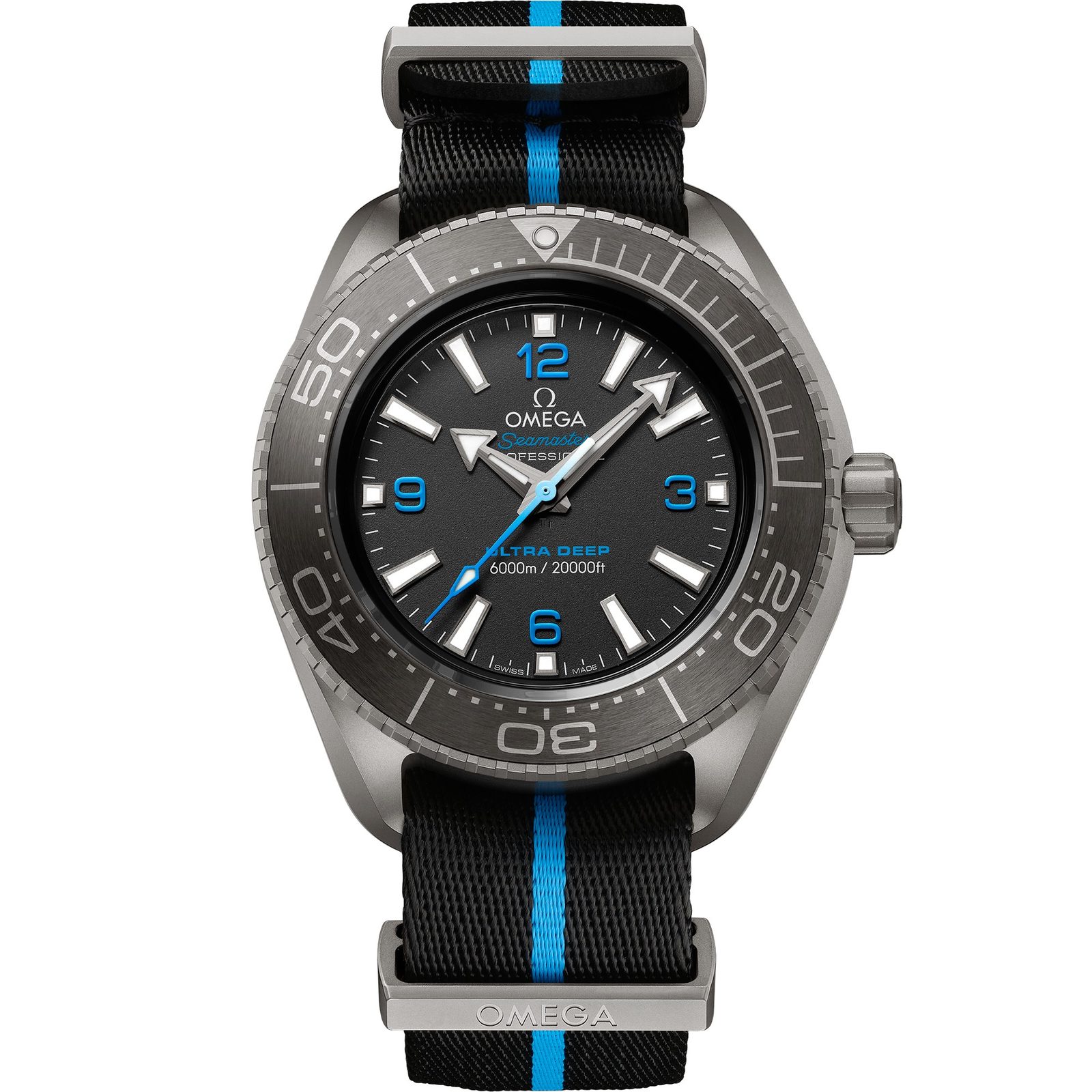
 OmegaSeamaster Planet Ocean Ultra Deep 6000M (Titanium)
 IWCPilot's Watch Performance Chronograph 41 AMG (Titanium)
Stay current
Titanium watchmaking is still moving. We add new current-production titanium watches continuously. Get an email when they land, or follow the RSS feed.
Frequently asked questions
What was the first titanium watch?
The Citizen X-8 Chronometer, released in 1970, is recognized as the first wristwatch with a titanium case. Citizen went on to develop its surface-hardened Super Titanium.
What was the first titanium dive watch?
Seiko's 600 m Professional of 1975, the original shrouded "Tuna," is widely credited as the first titanium dive watch, using titanium for its corrosion resistance and light weight.
When did luxury brands start using titanium?
Titanium reached luxury watchmaking in 1980 with the IWC Porsche Design Titan Chronograph, widely regarded as the first titanium chronograph. It moved fully upmarket in the 2000s with Richard Mille and titanium composites like Ceratanium.